
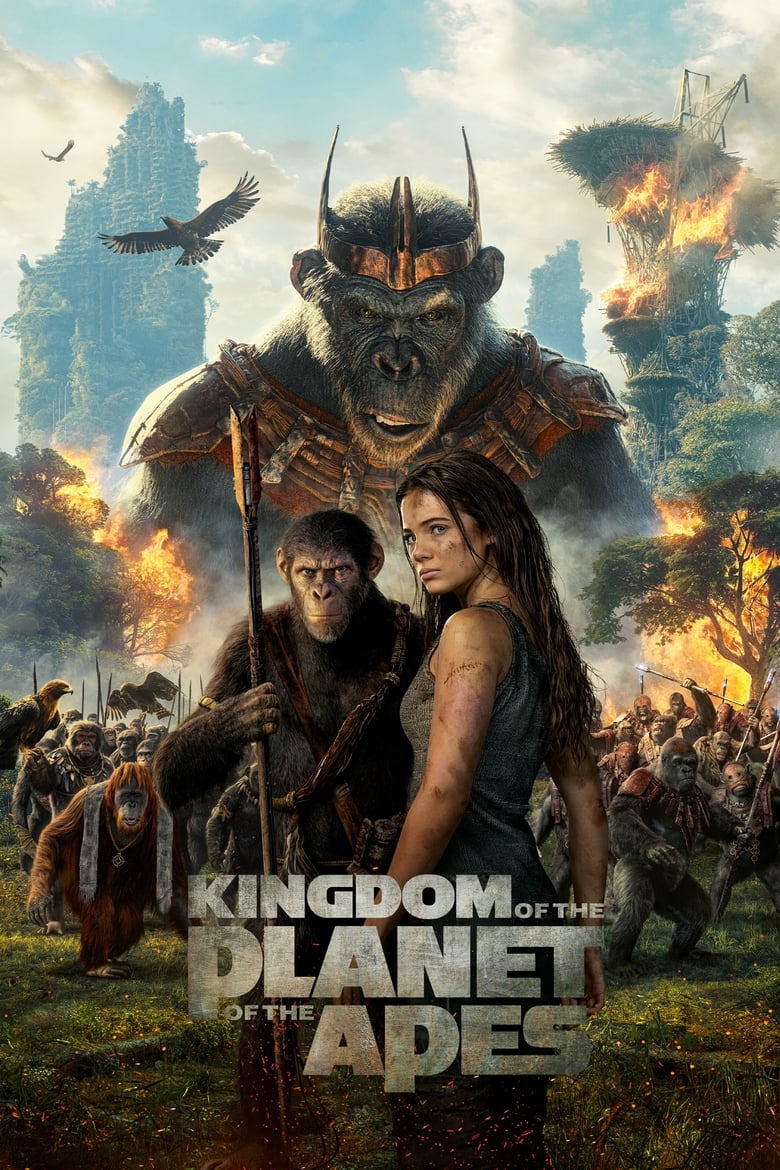
The Apes Have Inherited the Earth: A New Dawn or a Lingering Echo?
It's been a long time coming, but the wait is finally over. Kingdom of the Planet of the Apes has swung into cinemas, marking a bold new chapter in one of Hollywood's most enduring and thought-provoking franchises. Following the critically acclaimed reboot trilogy that concluded with 2017's War for the Planet of the Apes, director Wes Ball takes the reins, guiding us centuries into a future where ape civilization has truly taken root, and humanity is a mere shadow of its former self. But does this ambitious leap forward truly deliver a fresh narrative, or does it merely echo the greatness of its predecessors?
Make no mistake, this film is a visual spectacle, a testament to what modern CGI can achieve when paired with a compelling vision. The world-building is expansive, showing us lush, overgrown ruins and thriving ape communities built on the bones of human civilization. It’s a stark, beautiful, and sometimes terrifying vision of a planet irrevocably altered. However, the true test of any continuation lies not just in its aesthetics, but in its ability to innovate while honoring its legacy.
A New King, A New Conflict: Navigating the Savage Future
The narrative thrust of Kingdom of the Planet of the Apes centers on Noa (Owen Teague), a young chimpanzee from a peaceful, eagle-training clan. His idyllic life is shattered when his village is attacked by a technologically advanced, ruthless ape clan led by Proximus Caesar (Kevin Durand), a self-proclaimed king who has twisted Caesar's original teachings for his own tyrannical ends. Proximus Caesar believes in dominance and seeks ancient human technology to ensure ape supremacy, regardless of the cost.
Noa's quest to rescue his captured clan members and confront Proximus Caesar forms the backbone of the story. Along his journey, he encounters Raka (Peter Macon), an orangutan who clings faithfully to the true teachings of Caesar, believing in coexistence and compassion. Their dynamic provides much of the film's moral compass, contrasting the brute force of Proximus with the philosophical legacy of the franchise's foundational hero. It's a journey fraught with danger, unexpected alliances, and the chilling realization of humanity's true decline.
Characters and Performances: Finding Humanity in the Apes
Owen Teague delivers a nuanced performance as Noa, conveying a powerful arc from innocent youth to reluctant leader. He carries the emotional weight of the film, his expressions and movements imbued with a surprising depth that makes you forget you're watching a digital creation. Kevin Durand's Proximus Caesar is a formidable antagonist, charismatic yet utterly terrifying. He's not just a brute; he's a manipulator, twisting philosophy to justify his hunger for power, a chilling reflection of human history.
Perhaps the most intriguing addition is Mae (Freya Allan), a feral human who joins Noa's journey. Her presence reminds us of the delicate balance of this new world and the lingering questions about humanity's fate. Allan brings a captivating intensity to the role, communicating volumes without much dialogue. The film masterfully uses these characters to explore complex themes:
- The distortion of history and ideology for power.
- The fine line between survival and tyranny.
- The enduring struggle for freedom and self-determination.
- The potential for interspecies understanding, or renewed conflict.
- The cyclical nature of civilization's rise and fall.
These character dynamics, particularly between Noa, Raka, and Mae, are where the film truly shines, offering rich thematic material that elevates it beyond mere blockbuster entertainment.
Visual Grandeur and Direction: Apes Like You've Never Seen
Wes Ball, known for the Maze Runner series, proves himself a more than capable successor to Matt Reeves. His direction is assured, balancing moments of breathtaking action with quiet, intimate character beats. The CGI work, particularly the facial expressions and body language of the apes, is simply unparalleled. Every fur strand, every muscle flex, every subtle emotional shift is rendered with astonishing realism. It truly feels like you are watching sentient beings, not digital puppets. The scope is epic, showcasing vast landscapes and intricate ape settlements that feel lived-in and authentic.
The world of Kingdom of the Planet of the Apes is a character in itself, beautifully realized and constantly hinting at untold stories. While it doesn't quite reach the raw emotional intensity of something like Dune: Part Two in its sheer visual ambition, it carves out its own distinct aesthetic that is both beautiful and haunting. The cinematography is consistently stunning, making every frame a painting, whether it's a wide shot of a ruined city or a close-up of an ape's thoughtful gaze.
The Legacy Continues: What's Next for the Planet of the Apes?
Kingdom of the Planet of the Apes is more than just a standalone film; it's clearly designed as the launching pad for a new trilogy, or at least a new saga within the established universe. The film ends on a note that leaves plenty of room for future exploration, setting up intriguing possibilities for how the relationship between apes and the remnants of humanity will evolve. Its box office performance, while solid, indicates that audiences are still keen to see where this saga goes.
While some might argue it lacks the immediate emotional punch of Andy Serkis's Caesar-led films, it successfully broadens the scope and introduces compelling new characters and conflicts. It's a slower burn, more focused on world-building and philosophical exploration than immediate gratification, which is a commendable risk in today's blockbuster landscape. For fans of intelligent sci-fi and those who appreciate truly immersive cinematic experiences, this is an essential watch that promises much for the future.
